
Some links in this article may be affiliate links. If you buy through them, we may earn a commission at no extra cost to you. That income helps fund our testing and editorial work. It does not influence our scoring or our recommendations.
Specs at a Glance
| Category | Windows backup, clone, and sync software |
| Latest version | 8.3.0, released April 22, 2026 |
| No-cost edition | AOMEI Backupper Standard |
| Pro pricing | $39.95 per year or $69.95 lifetime, single PC |
| Family Lifetime | $89.95 for five PCs |
| Trial | 30-day trial of the licensed editions |
| Platforms | Windows 11, 10, 8.1, 8, 7; separate sync-only Mac app |
| Backup types | System, disk, partition, file, Outlook, email |
| Clone types | System, disk, partition (system clone is Pro and above) |
| Sync modes | Basic, Real-Time, Mirror, Two-Way (last three are Pro and above) |
| Encryption | AES-256, licensed editions only |
| Cloud | AOMEI Cloud, file backup only, 1 TB / 15-day trial |
| Ransomware Protection | New in 8.3.0, Pro and above |
| Support | 24/7/365 email for licensed editions; live chat Mon to Fri 9 to 18 |
Pricing and Editions
The free edition, AOMEI Backupper Standard, covers system, disk, partition, and file backup, plus basic file sync and limited cloning of data disks. It does not include differential backup, backup encryption, system clone, or real-time sync. For most home users wanting only file copies and a system image to an external drive, Standard is enough.
Professional adds the features most readers will actually want: system clone for SSD upgrades, differential backup, backup encryption, real-time and mirror sync, automatic cleanup of old images, and the new Ransomware Protection tool. It costs $39.95 per year on the official store, with a one-time lifetime license at $69.95. A Family Lifetime license covers five PCs for $89.95.
Above Pro sit Workstation, Server, Technician, and Technician Plus, aimed at small businesses, server admins, and IT services. Home users almost never need them. Every licensed edition gets a 30-day trial.
Installing the App and First Look at the Interface
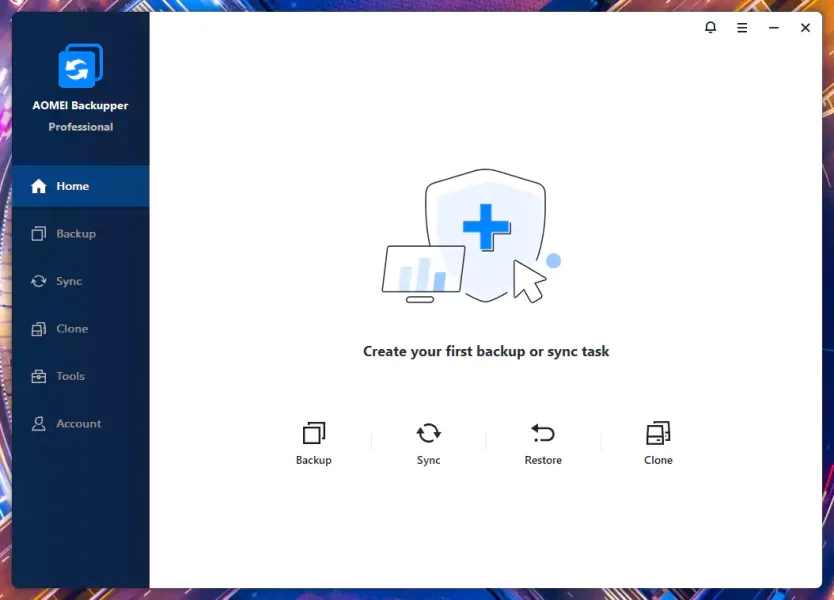
The Pro installer for AOMEI Backupper is small, around 212 MB, and the setup finished in under a minute on the test NVMe drive. Nothing in the build tested showed bundled offers or third-party adware. Once installed, the program adds a Start menu entry and an optional desktop shortcut.
The interface uses a left sidebar with six tabs: Home, Backup, Sync, Clone, Tools, and Account. From the Home tab, four large icons (Backup, Sync, Restore, Clone) help first-run users start a task, while the other tabs group the deeper options. A reader who has never opened a backup app should be able to find the right button without digging.
There are visible differences between editions. Standard shows a top banner promoting upgrades, plus “Pro” badges on locked features such as System Clone, Real-Time Sync, and Outlook Backup. The licensed Pro build removes the banners and unlocks those tiles cleanly. Version 8.0.0 also added a Lock feature that asks for a password each time the app starts, which is useful on shared family PCs.
Backup and Restore Performance in Practice
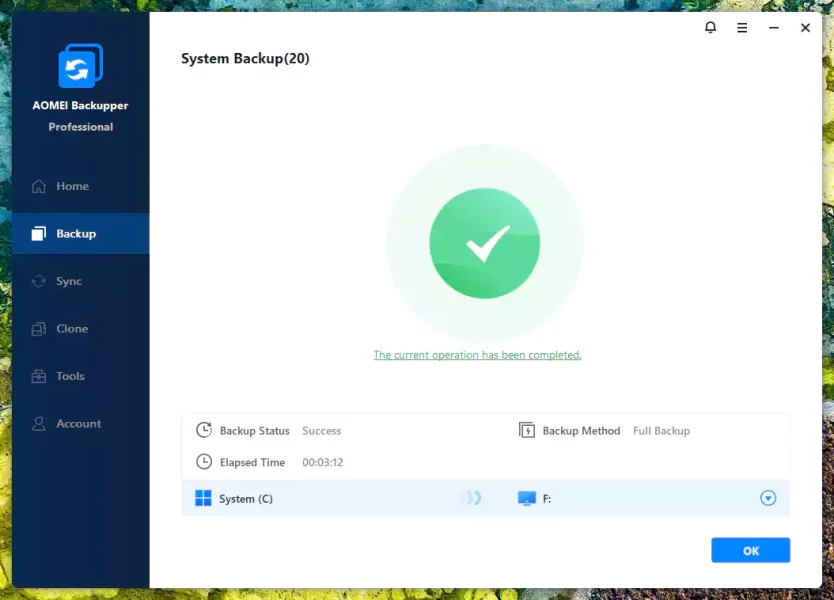
Backup speed and resource use are the core measures here. Tests ran on a Ryzen 9 9900X with 32 GB DDR5, a Samsung 990 Pro 1 TB system SSD, and a SanDisk Extreme Pro 1 TB USB SSD over USB 3.2. All settings stayed at default, with Microsoft VSS enabled. With 217 GB used on the system partition, a full system image to the external SSD finished in 3 minutes 12 seconds and produced a compressed file of 117 GB. CPU sat around 17% for most of the run, peaking near 53%, with memory usage of around 60 MB. Throughput worked out to roughly 1,157 MB per second.
The first incremental backup, taken after copying a 22 GB test folder into the user profile and updating an application, finished in 3 minutes 29 seconds and added about 21.9 GB to the chain. A second incremental after light daily use ran in 3 minutes 30 seconds and added 8.08 GB. Switching the same job to differential mode produced a 51.3 GB file in 4 minutes 1 second.
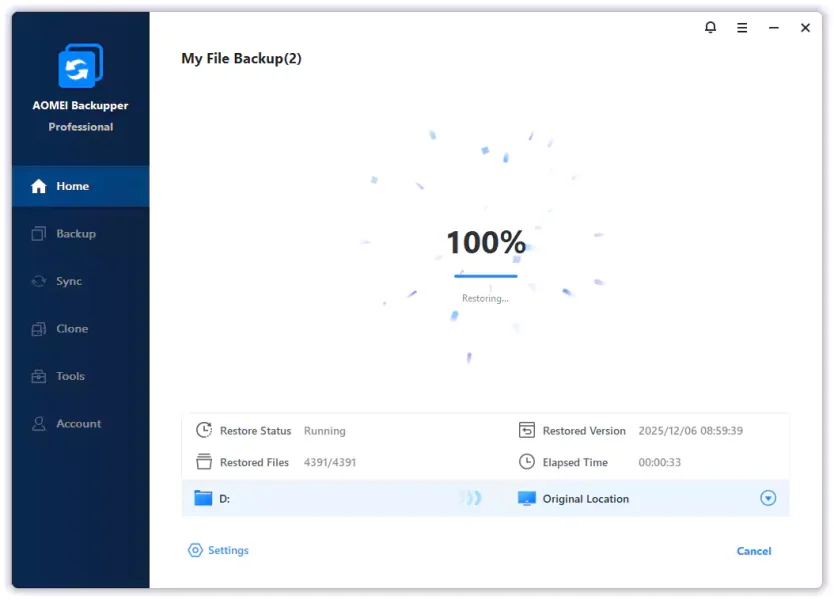
For file-level work, a folder of 4,391 files (totaling 11 GB across 314 subfolders) backed up in 2 minutes 14 seconds. The image compressed to 10.06 GB. After moving the original folder out, restoring it to the same path took 33 seconds. Every file came back with the original name and NTFS permissions intact, and the wizard clearly stated the destination before starting. Across all four runs, the UI stayed responsive and Windows did not lag.
These timings put AOMEI Backupper in the bracket where a daily image is practical, not just a quarterly one. A reader is more likely to keep a backup job scheduled when each run finishes in minutes rather than hours.
Incremental Versus Differential, in Plain Terms
An incremental backup saves only what changed since the last backup of any kind. It is small and fast, but a full restore must replay every link in the chain. A differential backup saves everything that changed since the last full image, growing larger each run. To restore, you only need the full image plus one differential file. Pick incremental for the smallest storage footprint, differential for simpler restores.
Cloning to a New SSD
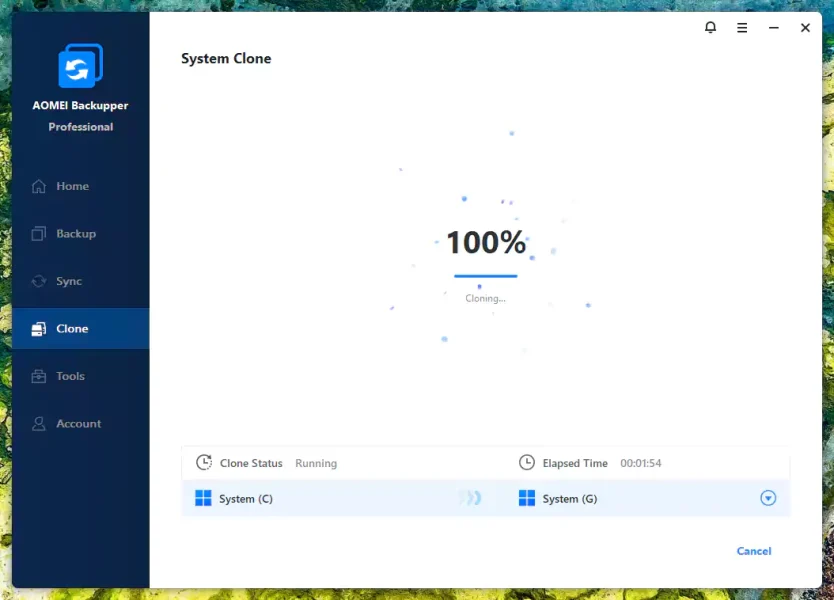
Cloning is often the reason someone buys a backup tool in the first place. The System Clone wizard in AOMEI Backupper Pro offers SSD alignment and the option to expand the system partition into the unused space on a larger target. With 208 GB used on the source disk and a 1 TB WD_BLACK SN850X as the target, the clone finished in 1 minute 54 seconds. After swapping the boot order, the cloned drive booted Windows on the first attempt, with the system partition automatically extended to fill the disk and 721 GB free.
There are caveats worth flagging. Per AOMEI’s own clone FAQ, dynamic disks and 4K-native targets are not supported by System Clone. Most home users will never hit those, but anyone running a server-style configuration should check before relying on the wizard. Disk Clone in the no-cost edition is limited to data disks; cloning a system disk requires Pro or higher.
Real-Time Sync for Working Folders
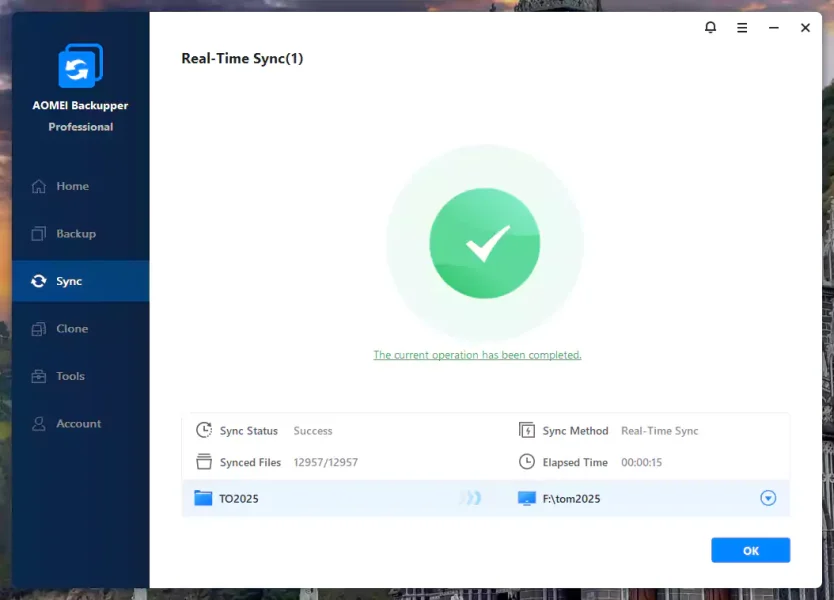
Sync is a different problem from backup, and AOMEI Backupper handles it as a separate module with four modes: Basic, Real-Time, Mirror, and Two-Way. During evaluation, a 28.1 GB working folder (mixed documents, project files, and a few 4 GB videos) was set up as a Real-Time Sync job to a folder on the external SSD. Across about 15 minutes of edits, new files, and deletions, changes appeared on the destination within 2 seconds. Deletions on the source mirrored to the destination within 2 to 3 seconds.
When the external SSD was unplugged, AOMEI Backupper did not surface an error. After reconnecting the drive, the sync resumed automatically. CPU usage stayed under 7% for small file edits and under 23% for the larger video moves, with disk activity in the medium-to-high range only during big writes. Those numbers are low enough to leave the sync running while you work. It is not a replacement for an image-based backup, since a synced folder mirrors deletions and corruption straight through, but it is a useful complement.
AOMEI Cloud and the 3-2-1 Question
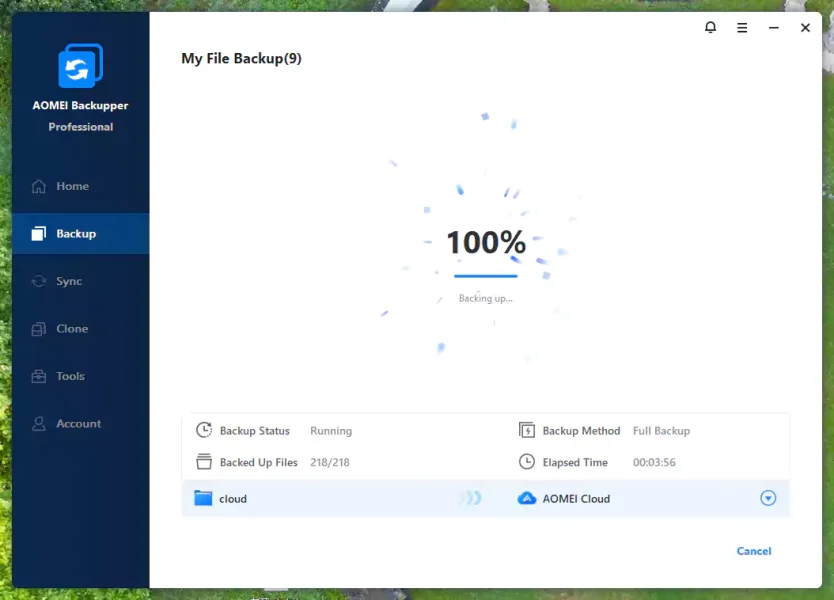
AOMEI Cloud is the company’s own cloud destination, offered as a 1 TB, 15-day trial for new accounts and built into the File Backup workflow. The first thing to know is what it is not: AOMEI Cloud supports file backup only. You cannot send a system image or a full disk backup to it. For a true 3-2-1 setup, you still need a local external drive or a NAS for the bare-metal image, with cloud handling documents and photos.
In practice, login is a separate step inside the app, after which AOMEI Cloud appears as a destination in the File Backup wizard. To gauge throughput, a 1.11 GB folder of 218 image files was uploaded over a 60 Mbps connection. The transfer took 3 minutes 56 seconds, an average of about 4.7 MB per second. By comparison, the same folder uploaded to Dropbox in 2 minutes 51 seconds at roughly 6.49 MB per second, suggesting some throttling on the AOMEI side. A subsequent download averaged 14.05 MB per second. CPU usage during upload stayed under 5%.
Login is one step and uploads start without further setup. For disaster recovery, however, an external drive remains the more practical destination.
Ransomware Protection and Encryption
Version 8.3.0 of AOMEI Backupper, released April 22, 2026, added a new Ransomware Protection feature in licensed editions. It is not an antivirus; it is a guard rail around the backup files themselves. Once enabled from the Tools tab, it stops other processes from modifying or deleting AOMEI image files, and you can extend the protection to specific file types and folders.
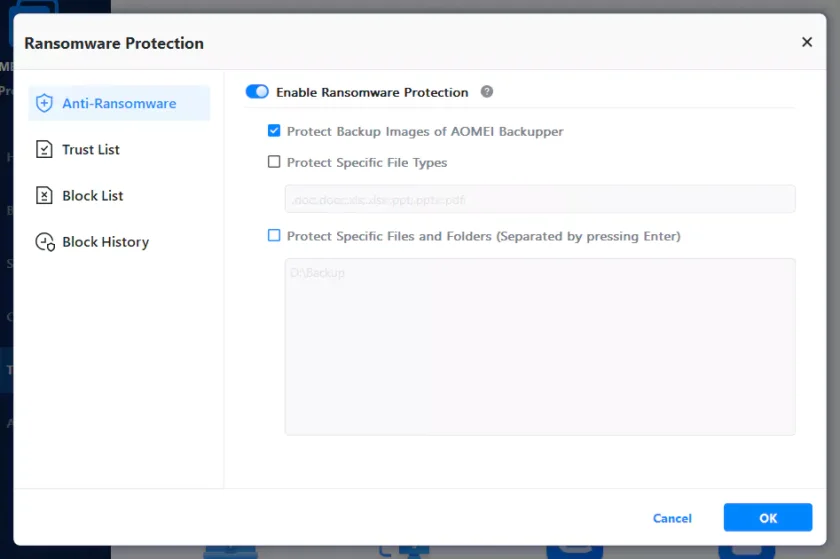
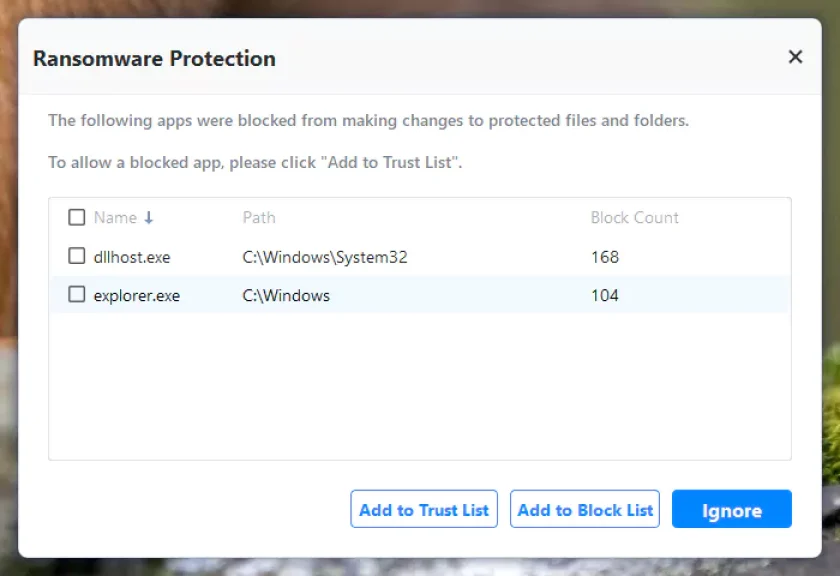
In hands-on checks, attempts to delete, rename, and move a backup image through Windows File Explorer were all blocked, as were command-line scripts trying to overwrite the file. Windows showed a standard “access denied” prompt, and the protection ran in the background with no measurable system drag over a 10-minute observation. Disabling the toggle restored normal file permissions immediately. The feature is simple, scoped, and effective against the basic ransomware behavior of mass file overwrites.
Encryption is the older security feature and uses AES-256, available only in the licensed editions. Two important constraints apply: encryption must be set when a backup task is created (you cannot add it to an existing job), and the password cannot be changed or recovered later. If you lose it, the backup is unrecoverable.
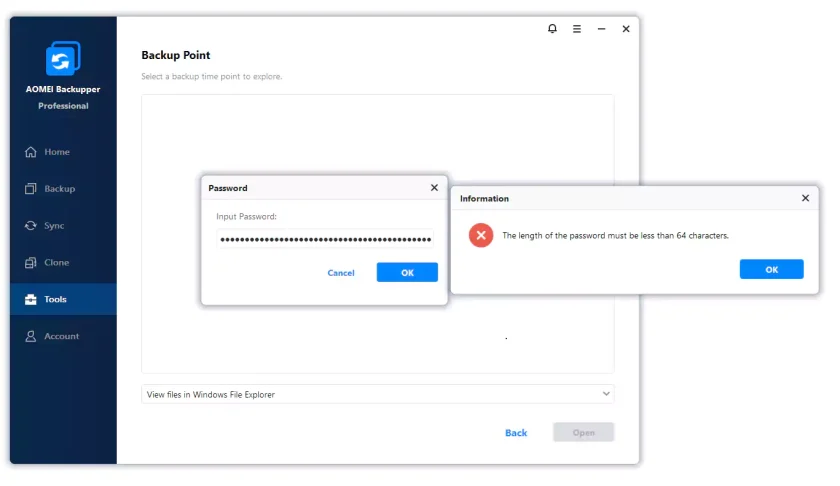
There is also a documentation conflict on password length. The official user manual states a maximum of 64 characters, while the help page on encryption states a maximum of 24. An in-app dialog observed during evaluation refused passwords of 65 characters or more, which lines up with the manual. Until AOMEI reconciles the two pages, keeping passwords below 24 characters is the safe choice. Either way, store the password in a password manager and run a test restore after enabling encryption.
Recovery Media and Bare-Metal Restore
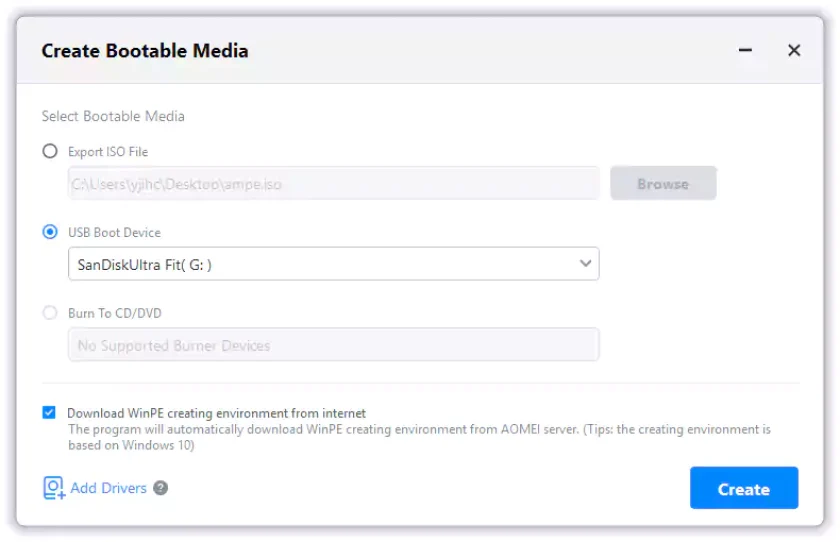
Recovery media is what makes a backup useful when Windows will not start. Tools, then Create Bootable Media in AOMEI Backupper offers three target options: ISO, USB, and CD/DVD. The wizard can download a WinPE creating environment from AOMEI’s servers automatically and add drivers if needed. On the test machine, the WinPE USB booted in 35 seconds and recognized both the internal NVMe drive and the external SSD without prompting for additional drivers.
Restoring the full system image from the external SSD took 5 minutes 29 seconds. After rebooting from the internal drive, Windows 11 started normally, and applications and settings matched the snapshot taken before the test. The wizard prompts users to confirm partition deletions on the target and warns about reactivating Windows and Office when restoring to dissimilar hardware. For someone who has never restored a system before, those prompts are helpful guard rails rather than friction.
Supported Systems, Limitations, and the Mac Question
AOMEI Backupper supports Windows 11, 10, 8.1, 8, and 7 across the personal editions, with Server, Technician, and Technician Plus covering Windows Server 2025, 2022, 2019, 2016, and 2012. Sector-size handling improved in version 8.1.0 (December 15, 2025), so 4Kn drives are now usable as both sources and targets, where earlier versions accepted them only as destinations.
There are two limits to be aware of. First, AOMEI Backupper does not support Windows on ARM, so Snapdragon X-class Copilot+ PCs are out of scope at present. Buyers using new ARM laptops should look at Macrium Reflect X Home or EaseUS Todo Backup, both of which now support that architecture. Second, the Mac version (AOMEI Backupper Mac) is a separate, no-cost product that handles file synchronization only. It does not image, clone, or back up disks. Treating the Windows and Mac apps as one cross-platform suite would be a mistake.
Customer Support and Refunds
Help channels for AOMEI Backupper are straightforward. Email support is available at support@aomeitech.com, and licensed editions are advertised as 24/7/365 on response. Live chat on the AOMEI website runs Monday through Friday from 9:00 to 18:00 (the company’s local business hours), so weekend questions go to email or the help docs. The Standard edition gets business-hours support only, which is reasonable for a no-cost product but worth knowing before you rely on it.
The refund policy is the standout: AOMEI’s 90-day unconditional money-back guarantee on paid purchases is longer than most direct competitors, which usually run 14 to 30 days. If you decide AOMEI Backupper Pro is not right for you, you have three months to ask for your money back without justifying the request.
How AOMEI Backupper Compares to Alternatives
For a Windows-only home or small-office buyer, AOMEI Backupper Pro sits in a crowded field, but its mix of features and price keeps it competitive. Acronis True Image bundles antivirus, anti-ransomware, and mobile device backup into a single suite, with cloud storage in higher tiers. That bundling justifies its higher annual price for users who want one product to replace both their antivirus and their backup tool. If you already have antivirus you trust, you are paying for overlap.
Macrium Reflect X Home is the choice most often picked by enthusiasts who want raw imaging speed, granular control, and native support for Windows on ARM. The company discontinued its no-cost edition and moved to subscription only, which makes the entry point steeper. EaseUS Todo Backup Home is roughly the same price as AOMEI Backupper, still offers a perpetual license, and added ARM support in March 2025. Its refund policy is conditional rather than unconditional.
For Windows users on x86 hardware who want imaging, cloning, and real-time sync in a single app, AOMEI Backupper Pro is the most direct fit. Buyers with ARM laptops, cross-platform households, or all-in-one security plus backup should look at the alternatives above.
Final Verdict
AOMEI Backupper Professional is a fair default for Windows home and small-office users on x86 hardware. Run the trial on your own hardware before paying, since the timings reported above came from one specific test rig and your results will vary with disk speed, file mix, and CPU load. Readers whose situation matches any of the caveats covered above should weigh the alternatives in the comparison section before buying.